


Page 8 - May-June2019 Vol37 No1
P. 8
KNOXVILLE                                             By Herschel Hall, P.E., G. Dwayne Frye, P.E. and Andrew Clark, P.E.
Second Creek Trunkline Rehab

  Knoxville Utilities Board (KUB) and Barge
Design Solutions, Inc. worked together to
address the Second Creek Trunkline’s structural
deficiencies while limiting impacts to stakeholders,
staying on schedule and within budget, and
managing several additional constraining factors.
Due to location, schedule, and the multitude of
stakeholders associated with this project, the
design team had to consider innovative solutions
throughout the life of the project. Responding to
these various constraints encouraged creativity
and resourcefulness, ultimately leading to the
most successful project possible.
Assessing the Existing Situation

  The KUB Second Creek Trunkline
Rehabilitation Project initially was identified as
needing extensive rehabilitation/replacement
during KUB’s trunkline inspection program
process. The inspection revealed significant
structural defects and a large ‘gusher’ that was
allowing a significant amount of infiltration to
enter the trunkline. The 1,350-LF trunkline is
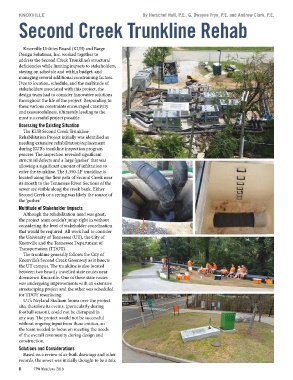
located along the flow path of Second Creek near
its mouth to the Tennessee River. Sections of the
sewer are visible along the creek bank. Either
Second Creek or a spring was likely the source of
the ‘gusher.’
Multitude of Stakeholder Impacts

  Although the rehabilitation need was great,
the project team couldn’t jump right in without
considering the level of stakeholder coordination
that would be required. All work had to consider
the University of Tennessee (UT), the City of
Knoxville and the Tennessee Department of
Transportation (TDOT).

  The trunkline generally follows the City of
Knoxville’s Second Creek Greenway as it bisects
the UT campus. The trunkline is also located
between two heavily travelled state routes near
downtown Knoxville. One of these state routes
was undergoing improvements with an extensive
streetscaping project and the other was scheduled
for TDOT resurfacing.

  UT’s Neyland Stadium looms over the project
site; therefore its events, (particularly during
football season), could not be disrupted in
any way. The project would not be successful
without ongoing input from these entities, so
the team needed to focus on meeting the needs
of the overall community during design and
construction.
Solutions and Considerations

  Based on a review of as-built drawings and other
records, the sewer was initially thought to be a mix

8	 TPW May/June 2019

