


Page 22 - JA26 TPW web
P. 22
By Sarah Grimm, WBG
         Proactive vs. Reactive Approaches:


         Underground Utility Construction


           “An ounce of prevention is worth   can achieve meaningful returns through   Stormwater Control Measures (SCMs)
         a pound of cure.” Though Benjamin   targeted, lower-cost maintenance     also play a vital preventative role. Regular
         Franklin coined this phrase in 1753   activities, including:             inspection and maintenance of assets
         in reference to fire safety, it remains   •  Routine ditch and channel cleaning    such as: bioretention areas, permeable
         highly relevant to today’s Public Works   •  Debris and sediment removal    pavement systems, sand filters and
         professionals tasked with managing   •  Vegetation management to maintain   detention basins can improve water
         aging infrastructure and increasingly   flow paths                       quality while protecting infrastructure
         constrained budgets.                  These efforts help prevent blockage that   sediment buildup and corrosion.
           For agencies managing stormwater,   can redirect water flow, accelerate erosion,   Proactive SCM management also supports
         water distribution, and transportation   and lead to flooding, roadway subsidence,   regulatory compliance and safeguards
         networks across Tennessee, preventative   and pipe failure.              downstream ecosystems.
         maintenance is not just a best practice, it
         is a critical strategy for protecting public
         safety, maintaining service reliability, and
         maximizing limited resources.
           Across municipalities, from small rural
         communities to large utility providers,
         the balance between proactive and
         reactive maintenance often is driven by
         cost considerations. While preventative
         programs require upfront investment,
         they consistently deliver long-term value
         through improved system performance
         and reduced lifecycle costs.
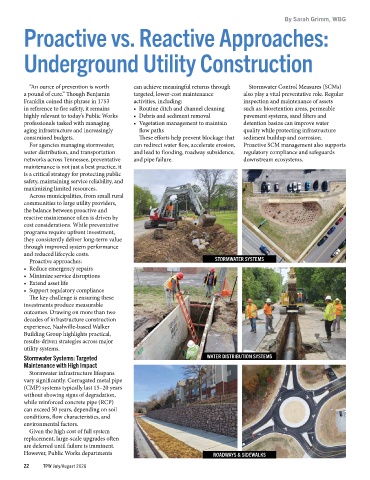
           Proactive approaches:                                        STORMWATER SYSTEMS
         •  Reduce emergency repairs
         •  Minimize service disruptions
         •  Extend asset life
         •  Support regulatory compliance
           The key challenge is ensuring these
         investments produce measurable
         outcomes. Drawing on more than two
         decades of infrastructure construction
         experience, Nashville-based Walker
         Building Group highlights practical,
         results-driven strategies across major
         utility systems.
         Stormwater Systems: Targeted                                WATER DISTRIBUTION SYSTEMS
         Maintenance with High Impact
           Stormwater infrastructure lifespans
         vary significantly. Corrugated metal pipe
         (CMP) systems typically last 15–20 years
         without showing signs of degradation,
         while reinforced concrete pipe (RCP)
         can exceed 50 years, depending on soil
         conditions, flow characteristics, and
         environmental factors.
           Given the high cost of full system
         replacement, large-scale upgrades often
         are deferred until failure is imminent.
         However, Public Works departments                              ROADWAYS & SIDEWALKS
         22    TPW July/August 2026

